Tuesday, 3 March 2015

Making the Most of Things: Rhubarb

Abundance, proliferation, plenty, bountifulness, shitloads, all great words when it comes to what we get from our gardens at times. Feast or famine as they say. However the downside is how many more ways can we prepare certain fruits or vegies to make use them all?

Zucchini or courgettes is an obvious one as when they grow there is a time when the come thick and fast. One I have struggled with is rhubarb. There are only so many crumbles, flans, slices, and gob loads on your cereal or muesli that a person can cope with. Particularly for a  a person with a limited sweet tooth.

Frugality is a mind set and it is important to clarify something right now. Frugality does not equate to being  a tightwad, a miser, a misery guts, a penny pincher, a Scrooge or money grubber. It is making the most of things, working on buying what you need rather than what you want, making the most of your money, enjoying the moment and what you have rather than what you do not have, and enjoying life. It is about using your brain to find solutions and learning to think outside the square.

Back to rhubarb, it is moderately prolific but unlike beans, peas, tomatoes, lettuce, green onions...you just can't eat it every day when it is around. But being frugal, I hated seeing good rhubarb not being used. There had to be a better way...
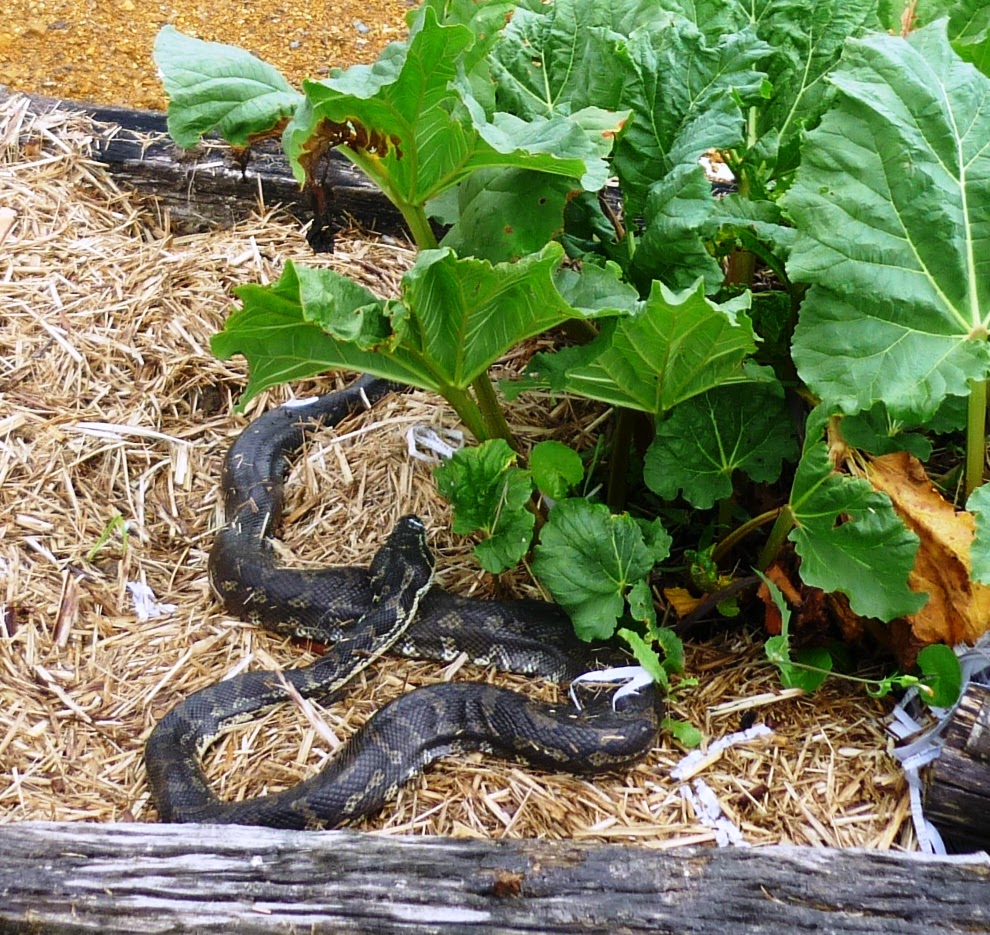
Oscar, our itinerant but regular visitor, lies near the rhubarb.

Rhubarb originates from China and has been used there for eons. However the use was medicinal. Marco Polo brought rhubarb back to Europe and  its use also spread to countries near China. So it is not surprising to find a recipe for savoury rhubarb with its roots in India.

I have made only the Rhubarb and Lentil Curry. It was wonderful and surprisingly there was really no taste of the rhubarb although its presence was felt in other ways. I look forward to trying the others and now making much more use of this wonderful vegetable.

According to Wikipedia, rhubarb is a vegetable although in the USA it is considered a fruit. This means there are lower duties and tariffs on the product.

The recipes were given to me so apologies to their origin as I know not whom to acknowledge and thank. Like all recipes, I use them as a guide, tweaking and adjusting to make use of what I have on hand and what I think will work. Adaptability is another key ingredient top frugality!  

Even though it is listed in recipe one, I never use olive oil when I am to heat it as it has a low smoke point and develops compounds that are carcinogenic with heat.I use a mild tasting high smoke point oil such as rice bran oil.

Rhubarb and Lentil Curry  Serves 6
·                                 2 Tbs. olive oil, divided
·                                 2 Tbs. yellow mustard seeds
·                                 2 ½ tsp. whole cumin seeds
·                                 3 Tbs. minced fresh ginger
·                                 3 cloves garlic, minced (1 Tbs.)
·                                 1 medium red onion, chopped (1½ cups)
·                                 ½ cup golden raisins
·                                 1 cup brown lentils, rinsed and drained
·                                 3 ½ cups  vegetable broth
·                                 ½ lb. fresh rhubarb, cut into ¼-inch slices, or ½ lb. frozen sliced rhubarb, thawed
·                                 6 cups baby spinach leaves
·                                 ½ cup chopped cilantro / coriander
Heat 1 Tbs. oil in nonstick skillet over medium-low heat. Add mustard and cumin seeds. Cover skillet, and cook 2 minutes, or until seeds begin to pop. Cook 1 to 2 minutes more, or until popping stops, shaking skillet often. Remove from heat, stir in ginger and garlic, and season with salt and pepper, if desired. Cover, and set aside.
Heat remaining 1 Tbs. oil in saucepan over medium heat. Add onion and raisins; sauté 10 minutes, or until onions begin to brown. Stir in lentils and 3 cups broth; bring to a boil. Reduce heat to medium-low; simmer 25 minutes. Stir in rhubarb and remaining 1/2 cup broth; cook 6 minutes. Add spinach, cover, and cook mixture 6 minutes more. Stir mixture to incorporate rhubarb and spinach leaves, then stir in spice mixture. Serve garnished with cilantro / coriander.

From another near neighbour to China, Iran. A recipe using rhubarb in a salad.

Thinly sliced cucumber and rhubarb tossed and left to stand for a while in salt, then mixed with rocket, lemon juice and a little mint,

Again from Iran; Rhubarb and lamb stew or khoresh.

 Soften a large onion in a mixture of groundnut oil and butter, then add 500g cubed lamb and brown. Stir in a pinch of saffron and 1 tsp pomegranate molasses, then pour in enough water to cover the meat. Simmer, covered, for 1½ hours. Half an hour into the cooking, fry a finely chopped large bunch of parsley and mint in butter and add to the stew. About 5–10 minutes before the stew is ready, add 3 sticks of rhubarb cut into 3cm pieces, stir once, cover and leave until the rhubarb is cooked but still holding its shape. Although fresh herbs generally lose their flavour when cooked, in this instance they're present in sufficient quantities for some flavour to survive, and their bulk serves the secondary purpose of thickening the sauce. Serve with basmati rice.

From Germany; Slow-cooked pork shoulder with tangy rhubarb and riesling recipe

Serves 4-6
2 red onions, peeled and halved
2 celery sticks, cut into quarters
3 bay leaves
2 sprigs of rosemary
½ pork shoulder, off the bone, skin removed and discarded
Olive oil
500ml/17fl oz off-dry wine, such as riesling or gewürztraminer
400g/14oz rhubarb, cut into 5cm lengths
Spinach, to serve
Preheat the oven to 180C/350F/gas 4. Spread the onions, celery, bay leaves and rosemary over the base of a very large baking tray. Season the pork very generously all over with salt and pepper and sit it on top of the vegetables. Drizzle with oil, then place in the oven for 30 minutes.
Pour over the wine and cover with a sheet of tin foil or greaseproof paper and return to the oven for 90 minutes, basting the meat every 30 minutes.
Place the rhubarb in a bowl, season well and toss in a little olive oil. Remove the covering from the pork and scatter the rhubarb pieces around the tray. Return to the oven, uncovered, for a final 30 minutes, until the rhubarb is tender and the meat is so soft that you can easily pull a bit off. Sometimes you will come across a shoulder that is tougher than others, so you may have to cover it again and return it to the oven for a bit longer until it's perfectly soft.

Sweet and Sour Rhubarb.

Lightly cooked slices of rhubarb are spooned atop spinach leaves and veiled with a warm sweet-and-sour dressing.

Ingredients:

4 stalks Rhubarb, cut diagonally into thin slices
1/4 cup sugar
2 tbsp. red wine vinegar
Salt and pepper to taste
16-20 spinach leaves
6 tbsp. vegetable oil 

Method:

Place the rhubarb in a wide saucepan. Sprinkle on the sugar and add enough water to cover by 1 inch. Place over high heat and bring to a boil. Cook, uncovered, for exactly 2 minutes. Remove from the heat and pour through a large sieve into a bowl. Return the liquid to the pan. Stir in the vinegar, salt and pepper, and place over high heat. Cook, uncovered, until the mixture is reduced to 1/2 cup. Meanwhile, divide the spinach among 4 salad plates. Arrange the rhubarb over the spinach. When the liquid is reduced, remove the pan from the heat and whisk in the oil. Pour over the salads and serve at once

Sunday, 1 March 2015

Weedy Plantain Steps up to the Plate.


A simple reminder as to what defines a weed comes from the Oxford dictionary;

A wild plant growing where it is not wanted and in competition with cultivated plants.

Other definitions introduce the word valueless. As beauty is in the eye of the beholder, weeds too are in the eye of the beholder. Weeds are like the someone else's errant child running  rampantly, raucously through the shopping centre; misunderstood. When the child is yours they are tired, or hungry or sick. To all else they are evil. To most weeds are evil but when you realise what little gold mines they are, you can't help but embrace them. It makes weeding the garden more appealing when you get tp eat some of the pull outs!

Weeds are a type of plant that happen to be very good at what they do.


  • They are often early colonisers of cleared land helping to break up the soil and provide a micro-climate for further plant development. 
  • Weeds often have a tap root which is the most amazing of  elevators, bringing nutrients from deep within the soil to the surface.
  • They can live in places few other plants would dare to and as we all know, they can take over an area and dominate. Okay I admit I don't like weeding and weeds can be a real pain but they are just following the course nature set for them. Some can be quite useful.
Broadleaf plantain
There are apparently over 250 species of plantain. I am not talking about the green banana like fruit but of a type of weed. Plantago major or broad leaf plantain is the shining light in the family, plantago lanceolata the reedy cousin. Originating from Europe they are widespread worldwide, their seeds the greatest hitchhikers on humans you could imagine. Additionally their seeds can survive the digestive turmoil of a birds gut, so globalisation is hardly surprising.

The value of broad leaf plantain has been analysed by scientists. As we are principally talking food here I won't go into that.  Needless to say, several of the active ingredients of plantain are used in modern medicines and creams. The active ingredients are involved in treatments for irritable bowel syndrome, constipation and somewhat surprisingly diarrhea, wound healing, tissue regeneration, disinfection, cholesterol lowering amongst others. As a treatment for a skin wound or insect bite at home or in the bush you could try making a poultice from the leaves of plantain and applying it. Checkout  http://www.drugs.com/npp/plantain.html if you are interested further in this side of plantain. You won't look at this humble little plant with contempt ever again!

We are talking principally about food and broad leaf plantain is an excellent vittle. The leaves are high in calcium and the vitamins A, C and K.
The young leaves can be eaten raw  but as the leaves age or if there is little water about for the plant, the leaves become stringy and are best cooked. Added to soups, stews or stocks the benefits will abound without any negatives.
The seed head that you can see in the photo below can be eaten as a snack when green. They can be cooked briefly too but again as these heads age, the inner stalk becomes stringy. They can still be eaten by pulling the seeds off with your teeth as if you were removing the kernels from a very small sweetcorn.


Broad leaf plantain

I mentioned Plantago lanceolata, the narrow leaf plantain, as being the reedy cousin of broad leaf plantain. The leaves too are edible more often blanched or fully cooked. The veins can be quite stringy and if you have the patience could be removed. If your first eating experience was from a plant growing in the crack of an inhospitable footpath, I am sure you would not return to a second sitting. But if the plant is growing in the well watered oasis that is your garden, you might succumb.

The leaves of both plantains can be made into a tea which supplies all of the restorative aspects, no strings attached!
Narrow leaf plantain

Remember when collecting plants away from your own garden limits, to ensure they have not been sprayed, are not contaminated in some other way and are in fact the plant you think they are.


Saturday, 21 February 2015

The cheap stuff; Eating leaves

Ignorance is a wonderful thing. The amazing thing about ignorance is the sufferer is oblivious to the condition. It would be wonderful if all ailments were the same. Ignorance has a simple cure and that is knowledge. The best knowledge I believe is when an individual seeks it out on their own.

I feel privileged to still have " Light bulb" moments in life. I was ruminating in my vegetable garden recently cutting the broccoli head away from the stem when I had the thought, " If the flower or broccoli head is edible, I wonder if the leaves are edible too? I must look it up." To make a long story truncated, I found that indeed they were edible and there are a whole heap of other "good parts" of vegetables either taken from the garden or bought from a shop that we lop off and throw out.

There is sometimes an issue with palatability but edibility no. It is sometimes a matter of thinking outside of the square to transform something a little different into something that can be eaten. Frugality is in part about making the most of things and reducing waste. This list of the edible items of vegetables  we often discard is not exhaustive but covers the majority hopefully. As far as recipes go that might utilise these parts, it is amazing what one can receive when you google a request.

Vegetable
Other Parts to eat
Beans
Leaves,
Beetroot
leaves
Broad Beans
The pod when young and not furry, tops of the plants
Broccoli
leaves, flower stem
Brussel Sprouts
Any leaf not just the small head
Carrot
leaves
Cauliflower
flower stem, leaves
Celery
leaves, seeds
Choko or Chayote
Leaves and tendrils
Sweet Corn
young ears, unfurled tassel, young leaves
Cucumber
stem tips and young leaves
Eggplant
leaves
Kohlrabi
leaves
Onions
young leaves
Parsley
roots
Peas
pods, leaves
Swede
leaves
Sweet Potatoes
leaves and stem shoots
Radish
leaves
Squash
seeds, flowers, young leaves


Notes:
  • leaves are always more palatable when young.
  • leaves that are chopped are always easier to disguise!
  • leaves that are edible but are not overly interesting to you can always be used in stocks. You at least get the nutrients.
  • If you add these lesser known leaves to salads use sparingly to begin with.
On the subject of leaves do not forget the weeds too.
Turmeric is easy to grow, looks great, the tubers can be harvested like ginger root and the leaves are a fantastic vegetable

Sweet potato. The leaves are a little bland but are great in a stir fry or with the addition of spices. Cook quickly.

My celery never looks like the bunches you get at the shop but it is prolific, all of it can be eaten, added to salads, soups, stocks and the like

Beans leaves best used finely chopped.

Silver beet or Swiss chard, not a great specimen but do not forget the stalks finely chopped are great in casseroles, soups or cooked as a  gratin.

Radish tops are great in soups and stocks

Monday, 9 February 2015

Dirty Rice and it's Done Dirt Cheap. A $5 challenge.

Dirty Rice and It’s Done Dirt Cheap, with apologies to AC/DC!

Dirty rice is easy to make. The best part about the dish, to make it is dirt cheap and should easily come in at under $5 as per the challenge.

Dirty rice gets its’ name from the off white colour the rice assumes during cooking. Dirty rice is generally linked to creole cuisine and the deep South of the United States of America. However, there are versions of it in many cuisines.  

To make dirty rice with a tip of the hat towards the creole favourite, this is one way to do it. However like many good dishes it is open to creativity so can then add what you want or have on hand.  

Makes enough to serve six and prices are in Australian dollars and are current as of February, 2015.

Ingredients:
2 cups white rice, 450gms at $3.95/kg  equates to $2.00
200 grams chicken livers @3.98/kg      equates to $0.80
1 stalk of celery                                                      $0.10
1 onion                             $0.99/kg                         $0.20
½ a green capsicum         $3.98/kg                          $0.75
4 cloves of garlic              $6.99/kg                        $0.30
¼ tsp cayenne pepper
Tsp black pepper
4 cups chicken stock

Total basic cost $4 or thereabouts.

Notes:
Chicken stock. Cheapest is to make your own using chicken necks as these too are $3.98/kg. We make our own as we make our own dog food. We feed our chooks instant noodles but never use the flavour packet. You could use the flavour packets although they do contain a lot of sodium if that is a concern. Adjust your seasoning to allow for added salt from packets or prepared stocks.

How to make dirty rice:

  • Prepare your ingredients first. It takes all the stress and strain out of preparing this dish and any stir fry.
  • Chop the chicken livers into about 5mm cubes. A fine chop but not pureed!
  • Chop the onion finely.
  • Chop the celery and capsicum reasonably small.
  • Chop the garlic.
You are ready to go.

  • In a good sized pan heat some oil. Brown the chicken livers. Don’t burn them. You are really just getting the ink or redness out of them.  This takes about three minutes.
  • Then add the onion and cook until the onion is translucent. Takes about two minutes.
  • Add the celery, capsicum and garlic and any seasoning and cook stirring for another three minutes or so then add the rice. Stir to coat the rice well with the contents then add the stock.
  • Bring to the boil then slowly simmer for twenty minutes with the lid on. Turn off the heat, lift the lid and fluff it all up with a fork.
  • Put the lid back on and leave for ten minutes

You could  serve this version of dirty rice  as an entree, as a  side dish or as  a main course. A salad would certainly complete the meal

The ingredient list is basic. The idea was to make a cheap dish that would still satisfy the taste buds. 

To take Dirty Rice from the Economy section and move it up to Premium or even Business you could add a few extras such as some extra pieces of chicken or pieces of sausage. Smoked sausage would keep with the creole mood but really if you are making the dish more universal, almost any sausage would work. The well known Asian dish chop suey which does not exist as an authentic dish in China,  means a dish made with all the left-overs. Dirty rice is a dish that can be varied easily by what you have on hand. A little creativity and courage is all you need. 


Monday, 2 February 2015

Wild and Free: Chickweed.

There are quite a few free edible goodies you can find to eat in Australia. I am not going to go into the realm of the foods the indigenous people of Australia eat from the native environment but look at another one that exists as a weed.

The majority of the weeds were  introduced with settlement in Australia by people's from over the seas. As such most of the introduced weeds are available in other parts of the world also.  Their ability to colonise and survive makes them almost universal plants, plants of the people for all the people. That is the kindest way to view them but then again I am not a farmer!

Chickweed or Stellaria media is a weed with a long culinary and medicinal history. The ancient Greeks record it usage.  It is remarkably high in the vitamins A,  B Complex, C, and D. Additionally it is high in Calcium, Zinc, Potassium, Manganese, Silica, Phosphorous, Sodium and Copper.
The medicinal qualities are numerous but as we are dealing with foods, if you are interested in what you can treat yourself with chickweed you can find this information yourself. Some people counter the medicinal claims of these free plants by saying, " Well if it is so good why can we not buy them as medicines?" Just remember medicines are about money. Weeds and the compounds within them cannot generally be patented hence the development of newer more marketable products. In fact you can access chickweed lotions balms and tonics in alternative medicine practices. I am not a naturopath so will stay away from that area.

But I do know a little about food. Chickweed is excellent as part of a salad. It  can be made into a soup or added to a soup as to be honest, I doubt you will ever be able to collect enough to make a soup of chickweed alone.. I will throw it in when making stocks. It is nice cooked with the minimum of butter and a little lemon juice. It makes a useful garnish. It is nice in a stir fry but when cooking with chickweed remember it requires a minimum of cooking so is best left to the end. It can be stringy so if in doubt, it pays to chop it prior to cooking.
Chickweed in the vegetable patch. It cuts down the growth of other weeds and acts as a natural growing mulch. Here it is among the beans. It gives you a relative size of what you are looking for.

Some notes on identification:
  • In Australia I live in a cool temperate area with reasonable rainfall. I can find chickweed all year round.Other sources claim it to be a plant of winter.
  • If you break the stem no milky sap spills forth.
  • Leaves are opposite on the stem not alternate.
  • The stem has one line of hairs running up it and these change side at each pair of leaves. However if you can readily see this feature you have very good eyes! It is clear under a magnifying glass.


As always when collecting weeds, be sure to know the area you are harvesting from has not been sprayed or is subject to some other form of contaminant.


Friday, 23 January 2015

The Five Dollar Challenge

The Five Dollar Challenge

The five dollar challenge is to create a meal for $5 or less.

Beans and Rice.

1 cup (225gms) Jasmine Rice @$3.95/kg = $1
300gms dried fava beans         @$2.95/kg=$0.90

The resultant meal provided enough for dinner for two, and four other servings which provided lunches and another dinner!

Here’s how:
A picture paints a thousand words or so they say so lets go.

Beans, fava beans, 300gms. Soaked overnight in water. There is a quick soak method where they say to boil for two minutes and then soak for a couple of hours in the hot water, I have tried this method and it did not work for me. Beans were still too hard after final cook. Oh well, they say to taste your food but it was serve or go to bed hungry!


Bring to the boil, do not add salt as it toughens the bean, gently boil for 45 minutes or so.


One cup of jasmine rice to two cups of water, bring to the boil then turn down as low as you can with the lid on. Cook for 15 to 20 minutes but check after 10 minutes or so to ensure it is not going to dry out. Add a touch more water if needed.

Cut some vegetables. I had on hand green onion, brown onion, red onion and leek. You can add what you want and please note, the cost of the vegetables were not added into the overall cost of the $5 challenge meal.


 As well as sow thistle, celery leaves, and a turmeric leaf.


With a little oil in a saucepan, the onions were given a bit of brown and then the greens were sweated down. A teaspoon each of cumin, cardamon and dry ginger were tossed in.


The beans and rice were added to the vegetables and some chopped green beans added. Taste and season as required. I added a handful of raisins at this stage too to add some sweetness. The whole lot  should then be turned and stirred and a little more water added as required and cooked a little more too your own personal taste of "doneness."
The side vegetables were sweetcorn, kale and cabbage with grilled tomato with a wasabi pea crust. The tomatoes were grilled nearly to the end then the crust added. Wasabi peas were ground, placed on top of the tomato with a spray of oil and finished under the grill.


Yummo!


 Variations:

The variations should suit your taste and budget. I used vegetables that were available free or were from our garden which we had grown. This dish works well though for when you see a vegetable that is on special and you can then employ it.

Beans; I used dried beans as they are cheapest. You could use any dried bean but the fava beans were the cheapest too. Chickpeas would work. 

Rice; Jasmine rice was, guess what, yep the cheapest. I bought these from a shop where you could get as much as you wanted from the self serve bins. Way cheaper than the supermarket and you only take what you want not a whole bag load. Brown rice, wild rice, black rice, white rice, red rice would all work beautifully and add different flavours too. Just check the recommended cook time. I cooked the ingredients separately to make sure all items were cooked adequately before bringing together. You could then also cook some of it in advance.

Vegetables to add; This part is wide open as to what you have available, what you are growing, what is cheap and in season. Wild and free greens like sow thistle, nettles, fat hen, plantain, chickweed would be good but anything can be added for colour, nutrients and flavour. 

Herbs and spices; Curry powder, cumin, cardamon, a pinch of nutmeg a little cinnamon would be great. Mixed herbs, thyme and sage would work. Coriander, lime zest, a splash of soya sauce, a slurp of sesame oil sounds good. Don't hesitate to add a spoon of sugar or use a dried fruit like raisins, currants, dates or prunes even.

Saturday, 17 January 2015

Free Mulch

Frugality can be applied in all aspects of existence and in fact is best practised as a way of life. Working in the garden is not exception.

“There is no dignity quite so impressive, and no independence quite so important, as living within your means.” 

This was uttered by Calvin Coolidge, who if you do not know, was the 30th President of the United States from 1923 to 1929.  I wonder how he would feel  now if he could see the current Age of Continuous Consumption and the reign of the credit card.  What an amazing thing the credit card, to make a card of debt sound positive!

Back to frugality in action, this time some suggestions for the garden. Mulch is a very important part of any garden to reduce water loss, stifle the growth of weeds, enhance the fertility of the soil and improve soil structure. However mulch costs  but by thinking outside the square, there are some frugal means to get all the benefits of mulching without it costing much money, a little time maybe but the pockets will not be siphoned free of gold.

Suggestions for cheap / free mulch:

  • Bark. We have cold winters so there is a constant requirement for firewood. Living frugally, this is collected throughout the year. As the branches are cut to size, the outer bark is removed and used as mulch. This mulch in particular is much more chook proof as our free range hens have greater difficulty using their feet to move it and it therefore acts as a home for all sorts of small wildlife. These are good to minimise pests.
Bark and some leaves used as mulch here. Note the wood ( free) used to add height and texture to the garden

  • Leaves. If there are fallen leaves about  they can be  used as mulch if present in sufficient numbers, these also make an excellent mulch. I always check to see what grows under the trees they come from as some leaves e.g pine needles are quite acidic and could kill certain plants.
Leaves can be used even around pot plants

Again a mixture of leaves in the foreground and bark


  • Prunings/ Thinnings. As trees are shaped all trimmings are kept to use as mulch. Thinnings from the fruit trees if the branches are thick enough, are dried, chopped to smaller sizes and used on the barbeque to smoke vegetables and meat. Free smoker chips! They are just soaked in water for an hour or so and I place them directly on the grill. Adds a lovely flavour.
Might look a little ugly or untidy to start but it soon settles down. Mulch around the new Camelia's. 

  • Weeds or unwanted plants. Never mulch with weeds that you have not taken the seed heads from. Otherwise, I use a range of weeds making sure they are in a position to dry out and not take root. I try to have the roots uppermost.
This is my weed graveyard. I put weeds here to dry out and then often move them at a later stage. This is settling down a lot and will soon be planted with grasses and flax.

These are sedges that were used originally as protection plants in one garden to help build a micro climate for the other new plants. Once the plants became established the sedge clumps were removed and used as mulch.

  • Lawn clippings.  I generally dry these out first before using so they do not form a thick layer that rots down and stops water passing through.
  • Other. If I purchase product it is usually a bag of sugar cane mulch. I use this in the vegetable garden as it is easy to use, cheap, the organic stuff is free of herbicides and a little goes a long way. In Australia, a $14 bag covers 6 square metres.


Make Mulch, Not War.